08 DB
DB summarizes whether the database contributes impact signals to SAP service.
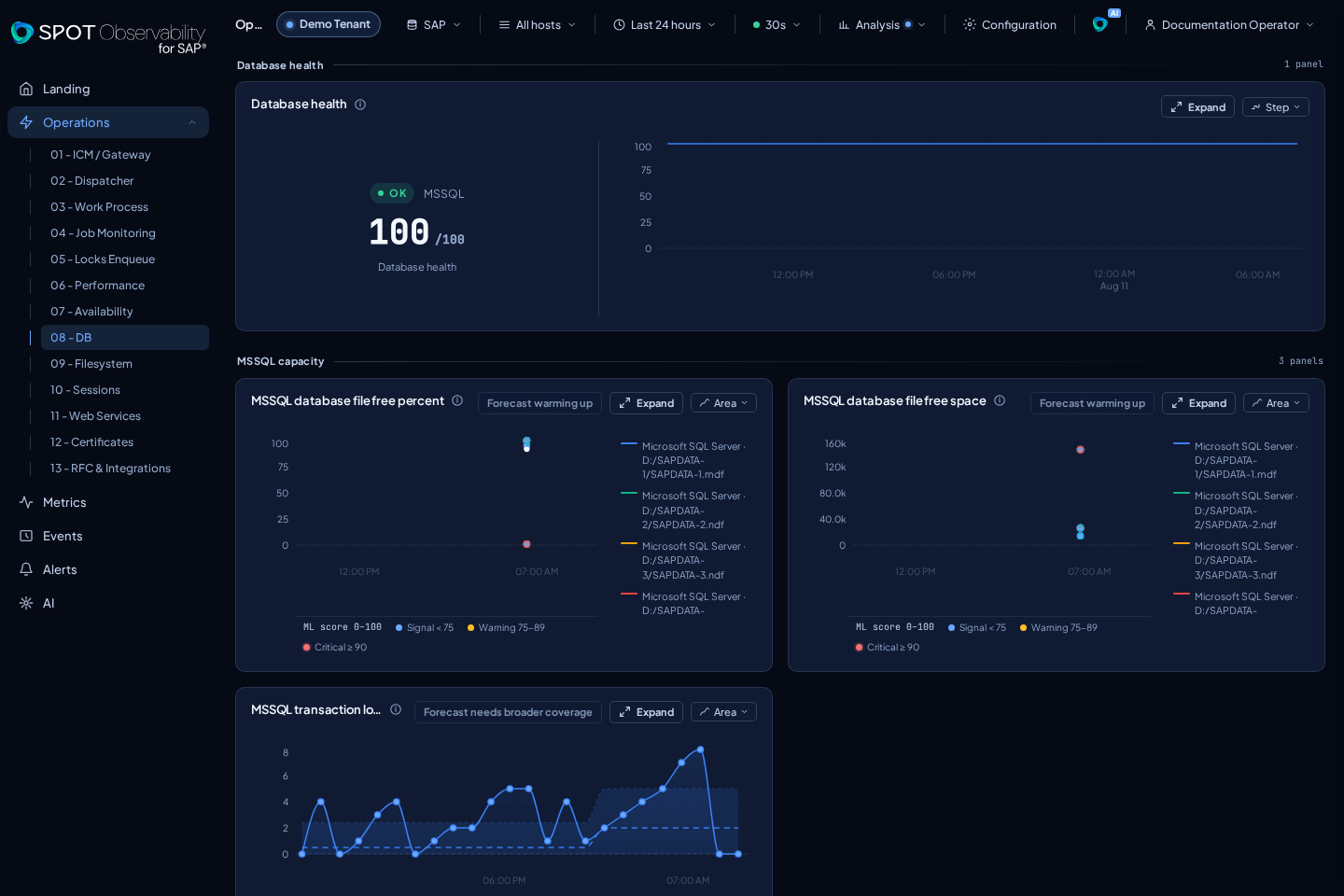
What appears
- Database health: a specialized card with engine, state, and 0–100 score, together with its trend.
- Oracle: three status cards and the tablespace table; they are not merged.
- MSSQL: signals ordered into Capacity, Performance, and Protection, in panel pairs that retain their line, area, or step variant.
- HANA: generic health when it is the available engine.
- Events remains at the end of the domain.
Engine-specific blocks appear only when applicable. When a section has only one applicable panel, it uses the full available width.
Each signal retains its real cadence: Database health is collected every 30 minutes and stays fresh for 90; I/O, hit ratio, page life, and oldest transaction use 15/45 minutes; transaction log and log backup use 1/3 hours; file free percent/space and backup age use 24/72 hours. SPOT connects samples only inside that horizon and never invents zeroes or extends a stale snapshot.
Database health is a state signal and does not offer Expected range, Forecast, or ML scores. Numeric DB panels keep Analysis when their canonical policy supports ML.
How to interpret it
- OK: DB health is normal and request time remains stable for the active window.
- WARN: DB latency, engine status, or related counters are drifting upward.
- KO: the database layer is clearly contributing to degraded dialog, batch, or availability.
UNKNOWN: no valid observation exists within that signal's own freshness; it does not mean that its last historical value was zero.
Do not read DB in isolation. A DB warning with normal dialog response may be a background trend; a DB warning together with Work Process saturation, canceled jobs, or high dialog response time is usually more actionable.
Filters and next screens
Use the same time range as the user-visible incident. Cross-check Performance for dialog and DB request time, Jobs for batch impact, Metrics for raw series, and Events for database or system messages in the same interval.